

Arab World English Journal (AWEJ) Volume 16. Number 1, March 2025 Pp.469-473
DOI: https://dx.doi.org/10.24093/awej/vol16no1.29
FULL PDF
Book review
Diversity, Equity, Inclusion and Intercultural Citizenship in Higher Education
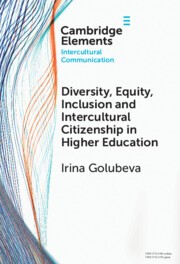
Author: Irina Golubeva
Title of book: Diversity, Equity, Inclusion and Intercultural Citizenship in Higher Education
Year of publication: 2025
Place of publication: Cambridge, United Kingdom
Publisher: Cambridge University Press
Pages: 104
Reviewer: Perizat Yelubayeva
How to cite: Yelubayeva, P. (2025). Book Review: Diversity, Equity, Inclusion and Intercultural Citizenship in Higher Education. Arab World English Journal, 16(1): https://dx.doi.org/10.24093/awej/vol16no1.29
In the highly polarized and dynamic world we live in today, Higher Education Institutions (HEI) are faced with the double challenge of fostering Diversity, Equity, and Inclusion (DEI) and Intercultural Citizenship Education (ICitE) while preparing students with intercultural and democratic competencies. Prof. Irina Golubeva’s book Diversity, Equity, Inclusion, and Intercultural Citizenship in Higher Education (2025) critically examines how HEIs embrace and navigate these challenges, noting that DEI and ICitE “are not universally supported disciplines” (p.7). The author argues that these two areas should be integrated into a unified educational framework that equips students to collaborate in local and global contexts.
This review explores Prof. Golubeva’s main arguments, evaluates their strengths and constraints, and considers their relevance to Kazakhstani higher education.
The five sections comprise the book. Section One sets the conceptual basis for differentiating the historical and theoretical differences between DEI and ICitE. It underlines the necessity of combining them, especially in light of the complications of the modern world. Dr. Golubeva argues that the independent domestic DEI policies and international ICitE programs are not realistic or cost-effective because students must gain intercultural competence (ICC) and democratic values to navigate the realities of local and global contexts.
In Two, the author also condemns the impact of neoliberalism on higher education, arguing that market-driven policies have commodified intercultural experience, namely study-abroad experience, ultimately reinforcing privilege and exclusion.
Section Tree emphasizes the constraints of applying study-abroad programs as the sole means of intercultural learning and exhibits significant detriments regarding finance and accessibility. Prof. Golubeva advocates for a different approach, utilizing Virtual Exchange (VE) and in-the-U.S. community-based projects as more sustainable solutions.
Section Four includes a description of the Training Framework and Activities model, which has been successfully utilized at a US Minority-Serving Institution (MSI). This model provides a structured approach to faculty training, student-centered intercultural learning, and policy changes at the institution, presenting real-world approaches to integrating DEI and ICitE initiatives.
The concluding section provides policy recommendations for integrating intercultural and democratic education into HEIs. The emphasis is on organizational reforms in the recruitment process, curriculum development, and institutional infrastructure in the longer term.
Strengths and Constraints
One of the book’s strongest points is its alignment with the Reference Framework of Competences for Democratic Culture (RFCDC) introduced by the Council of Europe (CoE, 2018). The framework enriches the interaction between intercultural and democratic competencies through a structured model with twenty main competencies regarding values, attitudes, skills, knowledge, and critical thinking. Prof. Golubeva contends that intercultural education should be embedded into the curriculum at an institutional level rather than relying solely on study-abroad programs. This perspective aligns with the RFCDC’s goals of fostering inclusivity, civic engagement, and critical thinking.
A key contribution of the book is its critique of the notion that ICC can only be developed within study-abroad programs. Prof. Golubeva underscores the exclusivity of international mobility, pointing out that students from low-income backgrounds, rural areas, and those with disabilities are often left out of these opportunities. Instead, the professor encourages HEIs to explore alternative approaches that offer all students meaningful intercultural experiences, such as:
– Virtual Exchange (VE) programs that enable students to connect with peers from different cultures without travelling abroad;
– Community-based intercultural learning, which allows students to engage with minority or immigrant groups within their local environment;
– Embedding intercultural and democratic competence development into HEI curricula, rather than constraining it to international programs.
These are consistent with the RFCDC vision of enabling students to become “active, democratic, and interculturally competent citizens” (p.3). The RFCDC model has twenty components that positively impact students’ attitudes, values, and competencies by fostering respect for diversity, receptivity to other perspectives, civic engagement, and critical thinking.
Another appealing aspect is its case study of a US MSI that successfully integrated DEI and ICitE. MSI facilitated staff training in intercultural pedagogy, facilitated local intercultural engagement with immigrant populations, and integrated policy to guarantee that domestic and international students developed global, intercultural, and citizenship competencies. Drawing on Byram’s (2008) theory of “intercultural citizenship,” Prof. Golubeva argues that HEIs could implement and practice this model to build more inclusive and equitable ICC and democratic citizenship education models. By promoting a systematic as opposed to a voluntary model for intercultural education, Prof. Golubeva reinforces the RFCDC’s focus on developing students’ civic participation, tolerance of ambiguity, and cultural diversity respect.
Prof. Golubeva is also critical of the neoliberal, profit-oriented approach to education since it is believed that most HEIs focus more on internationalization as a marketing strategy than genuine attempts to build ICC. The professor highlights the gap between DEI and ICitE in everyday institution practices claiming that: “HEIs struggle to provide professionally oriented knowledge and skills for their students’ future profession but have not typically incorporated teaching future citizens into their goals” (p.12). This is in line with broader scholarly reasoning about the corporatization of higher education, according to which institutions put more symbolic endeavors in the fields of diversity rather than effect meaningful transformations to get ready for multicultural surroundings that the students are soon going to confront (Echcharfy, 2022; Yelubayeva et al., 2016).
Although the book demonstrates significant strengths, some aspects require more in-depth analysis. Prof. Golubeva has effectively criticized the study-abroad-based model of intercultural learning. However, her arguments could extend further in analyzing the challenges that universities encounter in implementing various models, including VE, since its promotion relies on pragmatic issues such as access to technology, time zone differences, and the problem of institutional adoption (O’Dowd, 2023). Also, the debate would be complemented by researching lacunas in existing studies regarding the role of VE in covering physical mobility gaps, globalizing higher education, facilitating citizenship learning, and precisely quantifiable learning achievements. While VE ensures cost-effective and accessible intercultural exposure, it is equally essential to explore its likely limitations in creating extensive cultural immersion and transformative learning experiences compared to physical mobility (O’Dowd, 2023).
Similarly, while intercultural learning programs in community settings are essential, most HEIs find it challenging to adopt them because of requirements for long-term funding and intensive trainer development without additional incentives. Furthermore, while Prof. Golubeva condemns DEI’s American-centric bias, her conceptual model privileges Western contexts at the expense of non-Western universities. Her recommendations, for instance, for universities in post-Soviet countries like Kazakhstan may be subjected to context-sensitive adaptation to make them more applicable and realistic.
These constraints provide opportunities for further investigation in future intercultural education research.
Reflections on the book’s insights for Kazakhstani HEIs
The book’s findings are most relevant to Kazakhstan’s higher education, where integrating the RFCDC model would align intercultural competence development with multilingual education policy and national identity. RFCDC’s emphasis on critical thinking, civic engagement, and multi-perspectivity provides a systemic means of integrating intercultural learning into local curricula. For instance, Prof. Golubeva’s recommendations can be integrated in Kazakhstan by:
– involving local minority groups (such as Uyghur, Korean, or Uzbek nationalities) in educational programs;
– integrating intercultural training into teacher training;
– aligning multilingual education policy with general equity and inclusion goals.
However, there still remain challenges. The lack of a national DEI policy and potential resource constraints could hinder its implementation, requiring external funding or international cooperation (Gabdullina et al., 2024; Dossymbayeva et al., 2025).
Conclusion
Despite some constraints, the book Diversity, Equity, Inclusion, and Intercultural Citizenship in Higher Education significantly contributes to DEI and intercultural citizenship education discussions. Prof. Golubeva presents a strong case for implementing such frameworks within HEIs and reinforces the importance of moving beyond symbolic internationalization to ensure that all students gain democratic and intercultural competencies.
Prof. Golubeva’s recommendations emphasize the need for adaptation instead of direct borrowing in Kazakhstan. Kazakh universities must prioritize local intercultural interaction events, incorporate ICC into classes, and align language policies with equity and inclusion priorities (Berkinbayeva et al., 2023). By applying the RFCDC approach, Kazakhstani HEIs can create a more structured policy for democratic and intercultural education that prepares students for national and international citizenship.
Reviewer:
Perizat Yelubayeva is an associate professor at the Department of Language Theory at al-Farabi Kazakh National University (Almaty, Kazakhstan). Her primary research interests include higher language education, didactics, Teaching English as a Foreign Language (TEFL), intercultural communication, online learning, curriculum development, and the integration of media literacy into language education. ORCID ID: https://orcid.org/0000-0002-5534-0841
References
Berkinbayeva, G., Dauletbekova, Z., Yelubayeva, P., Bugybayeva, Z. (2023). 4C-Based Learning Model as an Effective Tool in Language Classrooms: The Case of Kazakh Schools. International Journal of Innovation and Learning. 34(1), 81–95.
DOI: https://doi.org/10.1504/IJIL.2023.132035
Byram, M. (2008). From Foreign Language Education to Education for Intercultural Citizenship: Essays and Reflections. Clevedon: Multilingual Matters.
Council of Europe (CoE). (2018). Reference Framework of Competences for Democratic Culture [3 volumes]. Accessed on February 20, 2025, from https://www.coe.int/en/web/reference-framework-of-competences-for-democratic-culture/rfcdc-volumes.
Dossymbayeva, A., Yelubayeva, P., Karabayeva, K. (2025). Adapting Instructional Materials for Distance Language Learning: Insights from Kazakh Higher Education after the Pandemic. Forum for Linguistic Studies. 7(1), 300–315. DOI: https://orcid.org/0009-0007-1815-5253
Echcharfy, M. (2022). Intercultural Citizenship Education: Towards Empowering Active Global Citizenship. Soft Skills et Didactique des Langues, 2, 189–211
Gabdullina, Z., Yelubayeva, P., Nemtchinova, E., Kulzhanbekova, G. (2024). Integrating Digital Authentic Materials in ESP Classrooms: Effects on Kazakh Students’ Language Proficiency and Student Engagement. Forum for Linguistic Studies. 6(4), 300–315. DOI:https://doi.org/10.30564/fls.v6i4.6712
Golubeva, I. (2025). Diversity, Equity, Inclusion and Intercultural Citizenship in Higher Education. Cambridge University Press. 104 pp.
O’Dowd, R. (2023). Internationalising higher education and the role of virtual exchange. Routledge. 164
Yelubayeva, P., Chaklikova, A., Asmatullayeva, N. (2016). Critical Discourse Analysis in Developing Vocational English Context. European Journal of Language Policy. 8(2), 209–223. DOI:https://doi.org/10.3828/ejlp.2016.13